


What Do the Eight Tibetan Auspicious Symbols Mean?
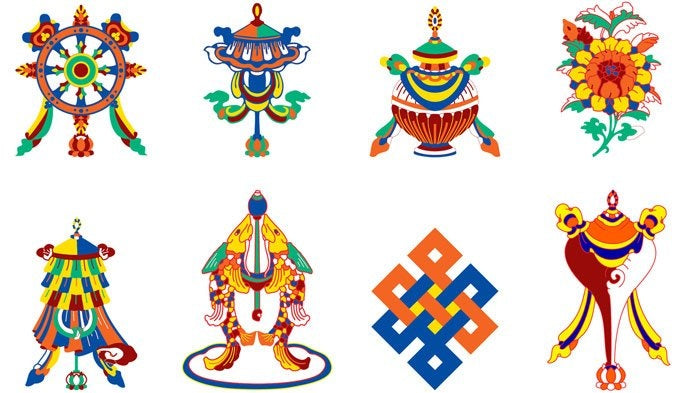
Walk into a Tibetan home, a monastery or even just a Tibetan shop, and you will meet them almost everywhere: a parasol, two fish, a round-bellied vase, a lotus flower, a conch shell, an interlaced knot, a banner and a wheel. Together they form the eight auspicious symbols, in Tibetan Tashi Tagye, in Sanskrit Ashtamangala. You see them painted on door beams, knotted into carpets, woven into khatas, on chests, teacups and jewellery. And yet many people who see them every day know only roughly what they mean.
In this article we introduce the eight symbols one by one: where they come from, how they are depicted, what meaning the Buddhist tradition gives them and what place they hold in everyday Tibetan life. We also clear up two common mix-ups and show how to treat these symbols with respect.
What are the eight auspicious symbols?
Tashi Tagye literally means "eight auspicious signs". Tashi is a word every Tibetan knows: it appears in the greeting Tashi Delek and stands for good fortune, blessing and success. The eight signs are:
- the precious parasol (Dug)
- the two golden fish (Sernya)
- the treasure vase (Bumpa)
- the lotus (Pema)
- the white right-turning conch (Dungkar)
- the endless knot (Pelbeu)
- the victory banner (Gyaltsen)
- the Dharma wheel (Chökyi Khorlo)
The order is not the same everywhere. It varies between texts and images depending on the tradition and the composition. The group itself, however, is fixed: it is always these eight.
The symbols are not deities and are not venerated in the way a Buddha statue is. They are images of the qualities of awakening and of the Buddha's teaching. Anyone who hangs them up or gives them as a gift is expressing good wishes: for a home, for a new stage of life, for someone setting out on a journey.
Where do the auspicious symbols come from?
The eight signs are older than Tibetan Buddhism. In ancient India, auspicious signs were part of the royal insignia and were used at coronations and festivals. Jainism also has its own group of eight auspicious signs, which partly overlaps with the Buddhist one. Buddhism adopted this visual language and gave it a new meaning: the signs of worldly power became images of the qualities of the Buddha and of his path.
According to a widespread tradition, the gods offered the eight symbols to the Buddha after he attained awakening under the Bodhi tree. Brahma is said to have presented him with a golden wheel with a thousand spokes, asking him to teach. Indra, king of the gods, brought him a white right-turning conch.
Another Tibetan interpretation links the eight signs to the body of the Buddha: the parasol stands for his head, the golden fish for his eyes, the vase for his neck, the lotus for his tongue, the conch for his speech, the endless knot for his mind, the victory banner for his body and the wheel for his feet. Taken together, the eight symbols thus form the image of an awakened being.
The auspicious symbols came to Tibet with Buddhism. There they became a firm part of art and everyday life, from the great monasteries to the tents of the nomads.
The precious parasol (Dug)
In India the parasol, in Sanskrit Chattra, was a sign of royal dignity. Whoever walked beneath a parasol was shaded from the sun, and the more parasols accompanied a ruler, the higher his rank. In the Buddhist visual language it became an image of protection: just as a parasol shields from scorching heat, the precious parasol is regarded as a sign of protection from suffering and from the inner restlessness that makes life heavy. It also stands for the dignity of the Buddha and for the cool shade his teaching offers.
In Tibetan art the parasol is usually shown made of silk, with a round dome, a flounced border and hanging ribbons. The long central shaft is often read as an axis linking heaven and earth. Large brocade parasols hang above statues and thrones in many monasteries.
The two golden fish (Sernya)
The two fish, in Sanskrit Suvarnamatsya, always appear as a pair, usually facing each other and often in the form of carp. Originally they represented the two sacred rivers of India, the Ganges and the Yamuna. In the Buddhist interpretation they symbolise happiness and freedom: just as fish move through water without fear or hindrance, a liberated mind crosses the ocean of existence without fear.
Because fish multiply quickly, they are also seen as a sign of abundance and fertility. In older depictions they are golden, their scales finely drawn and their tail fins ending in elegant curves.
A common mix-up: in some texts the golden fish are given the Sanskrit name Shrivatsa. That name, however, belongs to the endless knot, not to the fish.
The treasure vase (Bumpa)
The treasure vase is a round-bellied vessel with a narrow neck, closed by a lid from which a jewel often rises. It stands for inexhaustible abundance: however much is taken from it, it always remains full. The Buddhist tradition means above all inner wealth by this, that is, wisdom, compassion and the qualities that grow along the path. It also stands for long life and well-being.
The vase is not only an image. In Tibetan Buddhism there are real treasure vases, which are filled with precious substances, grain, medicinal herbs and prayers, then sealed and consecrated. They are placed on the home altar or buried at special places. The water vessels used in rituals and consecrations are also called Bumpa.
The lotus (Pema)
The lotus, in Sanskrit Padma, roots in the mud at the bottom of a pond, grows up through murky water and opens its flower, clean and unstained, above the surface. Few images describe the Buddhist path so clearly: the mind can awaken in the midst of life's confusion without being sullied by it.
The lotus therefore stands for purity, the purity of body, speech and mind, and for the possibility of awakening that lies in every human being. In Tibetan art, Buddhas and bodhisattvas almost always sit or stand on a lotus throne. The name of the great master Padmasambhava, in Tibetan Guru Rinpoche, also means "lotus-born".
The white conch (Dungkar)
In India the conch, in Sanskrit Shankha, was a war horn and a signal used to open assemblies. Its sound carries far. In the Buddhist interpretation it therefore stands for the voice of the teaching that spreads in all directions and wakes beings from the sleep of ignorance.
As an auspicious symbol the conch is white and right-turning: its spirals turn clockwise. Shells of this kind are rare in nature and have always been considered especially precious. Their direction of turning matches the movement of the sun, of the planets and of pilgrims who walk around holy places clockwise.
In Tibetan monasteries the conch is still an instrument today: monks blow it to call the assembly, and it is part of the music of many rituals.
The endless knot (Pelbeu)
The endless knot, in Sanskrit Shrivatsa, is a closed line that crosses itself again and again at right angles, without beginning or end. It is perhaps the best known of the eight symbols and is often shown on its own.
Its meaning lies in its form: everything is connected to everything else. The endless knot stands for the interdependence of all things, a central idea of the Buddhist teaching. It also stands for the inseparable union of wisdom and compassion, both of which are needed for awakening, and for the boundless wisdom of the Buddha. Because it has no end, it is also understood as a wish for a long and lasting bond, for example between people who love each other.
The victory banner (Gyaltsen)
The victory banner, in Sanskrit Dhvaja, was originally a standard that an army carried before it into battle. In Buddhism it stands for a different victory: that of insight over ignorance, fear, craving and hatred. According to tradition it recalls the moment when the Buddha, under the Bodhi tree, withstood every temptation and every fear.
The victory banner is shown as a tall cylindrical banner made of several layers of silk, often crowned by a small parasol or a jewel. On the roofs of Tibetan monasteries, banners of this kind rise as cylindrical ornaments of gilded metal, visible from afar.
The Dharma wheel (Chökyi Khorlo)
The Dharma wheel, in Sanskrit Dharmachakra, is one of the oldest images of the Buddha's teaching. The Buddha gave his first teaching in the Deer Park at Sarnath, near Varanasi. The tradition describes this event as "the first turning of the wheel of Dharma", and to this day people say that a teacher turns the wheel of Dharma when teaching.
The wheel usually has eight spokes. They stand for the Noble Eightfold Path, which the Buddha taught in this first teaching. A well-known interpretation also gives meaning to the other parts: the hub stands for ethical discipline, which gathers the mind, the spokes for wisdom, which cuts through ignorance, and the rim for meditation, which holds everything together. At the centre of the wheel you often see three or four swirls turning like a whirl.
Above many monastery gates in Tibet, Nepal and Bhutan sits a golden wheel, flanked by two kneeling deer. This depiction recalls the Deer Park where the Buddha first taught.
Dharma wheel or Wheel of Life?
The Dharma wheel is often confused with a completely different image: the Wheel of Life, in Tibetan Sipa Khorlo, in Sanskrit Bhavachakra. The Wheel of Life is a large mural often seen at the entrance of monasteries. It shows the cycle of birth, death and rebirth, the different realms of existence and the twelve links of dependent origination, held by a fearsome figure who embodies impermanence.
The Dharma wheel, by contrast, does not stand for the cycle of rebirth but for the way out of it: the teaching of the Buddha. Anyone who can tell the two wheels apart also understands why the Dharma wheel belongs to the auspicious symbols and the Wheel of Life does not.
The eight symbols in a single image
Most of the time the eight auspicious symbols are shown individually, side by side, in a circle or in the eight panels of a wall hanging. There is, however, also a combined form in which all eight are brought together in one image. It often has the outline of a vase: the parasol at the top, the conch below it, the two fish at the sides, the wheel in the middle, the endless knot and the lotus further down, and the whole rests on the treasure vase or merges with it.
This condensed form shows that the eight symbols belong together. They are not eight separate lucky charms but eight aspects of a single path.
How are the auspicious symbols depicted?
Tibetan art follows established patterns for the eight symbols but leaves plenty of room for creativity. The signs are mostly painted in gold or in strong colours, red, blue, green and yellow, and are often decorated with fluttering silk ribbons, small jewels or a wreath of flames. Each symbol often rests on its own small lotus flower, as a sign that it is considered precious and pure.
On wall hangings and thangkas the eight signs are often arranged in a row or a circle, on door curtains and cushion covers more often within a frame of cloud motifs. In metal, for example on offering bowls, incense burners or jewellery, they are embossed, engraved or cast. However varied the execution, the basic shape of each symbol remains recognisable: anyone who knows the eight signs will find them on a carpet just as on a small pendant.
Where do you meet the auspicious symbols in everyday Tibetan life?
The eight auspicious symbols are everywhere in Tibetan culture, and not only in monasteries. You find them on the painted beams and doors of houses, on wooden chests, cupboards and altar tables, knotted into the patterns of carpets and cushion covers, and on teacups, butter lamps and incense burners.
They are also often woven into khatas, the white auspicious scarves offered as a welcome, at farewells or as a gift. For the Tibetan New Year, Losar, and to welcome great teachers, in many places they are drawn with white flour or chalk on the ground in front of the house, as a greeting and a wish for a good new year.
In painting the symbols appear on thangkas, often in the margins or below the throne of a deity. As an offering on the home altar they sometimes stand in a row as small metal figures. And many people carry them with them as a pendant, bracelet or key chain, as a quiet reminder of the good wishes they stand for.
Related groups not to confuse
Alongside the eight auspicious symbols, Tibetan art knows other groups of signs that look similar and are often shown together.
The eight auspicious substances, in Tibetan Tashi Dzegye, are gifts that the Buddha received according to tradition: a mirror, a precious remedy of animal origin, yoghurt, durva grass, a bilva fruit, a right-turning conch, vermilion powder and white mustard seeds. The conch therefore appears in both groups.
The seven jewels of royal power, in Tibetan Gyalsi Rinchen Nadün, are the insignia of a just ruler who reigns over the world: the precious wheel, the precious jewel, the precious queen, the precious minister, the precious elephant, the precious horse and the precious general. Here, too, a wheel appears, but it has a different meaning from the Dharma wheel among the auspicious symbols.
Anyone who knows these groups reads Tibetan images more precisely and understands why an altar or a thangka sometimes shows more than eight signs.
What do the auspicious symbols mean today?
For Tibetans in exile, the eight auspicious symbols are also a piece of home. They hang in the houses of families who have lived far from Tibet for decades and accompany weddings, births, house moves and the New Year festival. They connect the younger generation with the visual language of their grandparents.
For people interested in Buddhism, the symbols are a good place to start. Each of them leads to a central idea of the teaching: to the purity of the mind with the lotus, to the interdependence of all things with the endless knot, to the path of the Buddha with the wheel. Anyone who spends time with the eight signs learns a great deal about the Buddhist view of life along the way.
One thing matters: the auspicious symbols do not work on their own. They are not talismans that make happiness appear. Their meaning lies in what they remind us of and in the good wishes with which they are hung up or given.
How do you treat these symbols with respect?
The eight auspicious symbols belong to a living religious tradition. You do not need to be a Buddhist to own a piece that bears them, but it is good to know what they stand for. A few simple gestures show respect:
Handle objects bearing these symbols with care and keep them clean. A wall hanging or thangka with the eight signs is best placed somewhere calm and raised, not in the bathroom and not at floor level. If you give a piece as a gift, add a good wish for the person receiving it, just as Tibetan families do.
And if you are not sure what a sign means, please ask. In our shop in Zurich's Niederdorf we are always happy to talk about it.
Frequently asked questions about the eight auspicious symbols
What are the eight auspicious symbols called in Tibetan?
The group is called Tashi Tagye, "eight auspicious signs". The individual symbols are Dug (parasol), Sernya (golden fish), Bumpa (treasure vase), Pema (lotus), Dungkar (conch), Pelbeu (endless knot), Gyaltsen (victory banner) and Chökyi Khorlo (Dharma wheel).
Can I wear the auspicious symbols without being a Buddhist?
Yes. In Tibetan culture the eight symbols also express good wishes and are worn and given by many people. What matters is treating them with respect and knowing what they stand for.
Is the Dharma wheel the same as the Wheel of Life?
No. The Wheel of Life shows the cycle of birth, death and rebirth. The Dharma wheel stands for the teaching of the Buddha, which leads out of this cycle. Only the Dharma wheel belongs to the eight auspicious symbols.
Why does the conch turn to the right?
Right-turning conch shells are rare in nature and have therefore always been considered especially precious. Their spiral follows the course of the sun and the direction in which pilgrims walk around holy places.
Which symbol suits which occasion?
All eight together express complete good wishes and suit almost any occasion. Because of their meaning, the endless knot suits a wedding well, as an image of a lasting bond, the treasure vase a new home, as a wish for abundance, and the Dharma wheel someone who is interested in the Buddhist path.
The auspicious symbols in our shop
Many pieces in our range bear the eight auspicious symbols: wall hangings and small thangkas for the home altar, khatas for welcoming guests, water bowls for the daily offering, incense holders, pendants and key chains. You will find a selection in our Auspicious Symbols collection. Each of these pieces carries the same eight signs that have accompanied homes, monasteries and people for centuries, as an expression of good wishes for your path.
Tashi Delek.


Leave a comment
This site is protected by hCaptcha and the hCaptcha Privacy Policy and Terms of Service apply.