


Lhabab Düchen: The Buddha's Return from Heaven
Lhabab Düchen is a festival of return, gratitude and light in the Tibetan autumn.
What is Lhabab Düchen?
When the nights grow longer in the Himalayas and the first cold winds cross the passes, the Tibetan world observes one of its quietest and at the same time most important festivals: Lhabab Düchen, the day on which Buddha Shakyamuni returned to earth from the Heaven of the Thirty-Three. It falls on the 22nd day of the ninth month of the Tibetan lunar calendar, which in the Gregorian calendar usually means late October or November. In 2026, Lhabab Düchen falls on Sunday, 1 November.
The name explains the event. Lhabab means in Tibetan roughly “descent from the realm of the gods”, and Düchen means “great event” or “important occasion”. Lhabab Düchen is therefore, literally, the great event of the descent. In German and English texts you will also come across the spelling Lhabab Duchen, without the umlaut; it is the same festival.
For practitioners of Tibetan Buddhism, this day is one of the four great Düchen of the year, those special days on which positive and negative actions alike are multiplied in their karmic effect. On Lhabab Düchen itself, the karmic force of every action is said to be increased one hundred million times. What is done, said and thought on this day carries, according to this understanding, a particular weight.
The Four Great Düchen of the Tibetan Year
The Tibetan calendar knows four days that commemorate decisive events in the life of the Buddha and are called Düchen. Chotrul Düchen, on the 15th day of the first month, recalls the miracles the Buddha performed to convince doubters of his teaching. Saga Dawa Düchen, on the 15th day of the fourth month, unites birth, enlightenment and Parinirvana; we have devoted a separate article to this holiest of months: Saga Dawa. Chökhor Düchen, on the 4th day of the sixth month, celebrates the first teaching, the first turning of the wheel of the Dharma. Lhabab Düchen, on the 22nd day of the ninth month, closes this circle with the Buddha's return from heaven.
Together, the four days form the backbone of the Tibetan festival year. You will find a shorter overview of these and other festivals in our article Tibetan Festivals. The present article goes deeper into what is only touched on there: the story behind Lhabab Düchen, the lived practice, and the question of what this day can say to us today.
The Story: The Buddha's Ascent to the Heaven of the Thirty-Three
To understand Lhabab Düchen, one has to begin with the mother of the Buddha. According to tradition, Queen Mayadevi died seven days after the birth of her son Siddhartha. The prince was raised by her sister Mahaprajapati Gautami, who would later become the first nun of the Buddhist community. Mayadevi herself, it is said, was reborn in a realm of the gods.
Years after his enlightenment, so the tradition tells, the Buddha went for the duration of one rainy season to the Heaven of the Thirty-Three, in Sanskrit Trayastrimsa, the heaven of the gods over which Indra presides. There he taught the Dharma for three months, to his mother and to the assembled gods. According to Tibetan tradition, it was during this time that he transmitted the Abhidharma, the part of the teaching that analyses mind, perception and phenomena into their finest components. Mayadevi, it is reported, found through this teaching the entrance to liberation.
In some versions of the story, Mayadevi is reborn in Tushita heaven and comes from there to the Heaven of the Thirty-Three to hear her son. This explains why accounts of the festival sometimes name both heavens. In the Tibetan tradition, however, the place of the teaching and the starting point of the return is the Heaven of the Thirty-Three.
What led the Buddha there was no longing for heavenly rest. It was gratitude. The Awakened One, who had nothing left to attain for himself, ascended to repay the kindness of his mother, who had given him life and lost her own for it. This motivation is the heart of the festival, and it will occupy us again in the course of this article.
The Descent at Sankasya: The Triple Staircase
On earth, the disciples missed their teacher. Maudgalyayana, known among them for his supernatural abilities, ascended to heaven according to tradition and asked the Buddha, on behalf of the community, to return. The Buddha agreed, and on the 22nd day of the ninth month he descended.
The accounts paint this moment in luminous images. A triple staircase of gold, silver and jewels reached from heaven down to earth. The Buddha descended by the middle staircase, accompanied by Brahma and Indra, the two highest gods of the Indian world, who escorted him on the two outer staircases. Gods and humans saw one another in that moment, and heaven, it is said, opened itself to every gaze.
The place of the descent was Sankasya, today's Sankissa in northern India. Since ancient times it has counted among the eight great sites in the life of the Buddha, alongside Lumbini, Bodhgaya, Sarnath and Kushinagar. A pillar of Emperor Ashoka with an elephant capital still commemorates the event there today. Tibetan pilgrims travelling to India visit Sankasya as a place where heaven and earth once touched.
Lhabab Düchen and the Weight of Actions
The idea that the effect of every action is multiplied on this day shapes the attitude with which Tibetans observe Lhabab Düchen. It is not a day for drifting. Many pay conscious attention to their words, their thoughts and the way they treat others. Quarrels are avoided, generosity is sought, and those who otherwise practise little set aside time on this day for prayer and stillness.
For many, the lived discipline includes abstaining from meat on this day. It is an expression of non-violence towards all living beings and a reminder that the Buddha's teaching concerns not only the mind but also the table. Some additionally take the eight Mahayana precepts, a one-day commitment to a simple, mindful way of living.
The idea of the multiplied effect is not a numbers game. It invites us to place the quality of our everyday actions under a magnifying glass for one day and to see what we usually overlook.
Traditions and Rituals: What Happens on Lhabab Düchen
In monasteries and temples, the day begins early. Monks and nuns recite prayers and texts, and many monasteries hold extended puja ceremonies. Lay people visit the temples, make offerings and prostrate before the images of the Buddha. The prostration, in which the whole body touches the ground, is a particularly widespread practice on this day. It unites body, speech and mind in a single gesture of reverence.
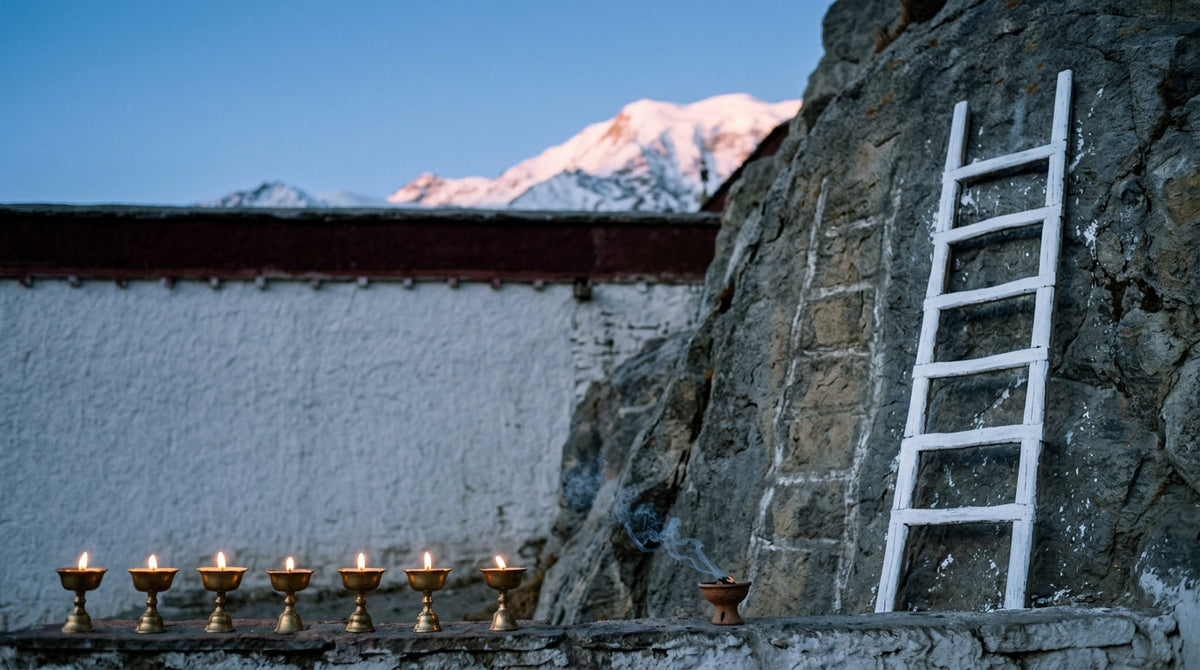
Butter lamps are lit in great numbers, in the temples and at home. Incense and sang rituals accompany the day. In the sang, a smoke offering of juniper and herbs is made on rooftops and in elevated places, its smoke understood in Tibetan tradition to purify and to delight the Buddhas, the protector deities and the local spirits. Traditional Tibetan incense such as Riwo Sangchoe, used for the smoke-offering ritual of the same name, has its established place on Lhabab Düchen.
Mantras are recited throughout the day, alone, in the family or in community. Pilgrimages to sacred sites and the circumambulation of temples, stupas and monasteries are part of it too. In Lhasa, numerous pilgrims gather around the Jokhang temple on this day and circle it, many with a prayer wheel and a mala in hand. Generosity shows itself in donations to monasteries, in meals for those in need and in the ransoming of animals destined for slaughter.
Freshly Painted Ladders: An Image of the Descent
One particular feature of Lhabab Düchen is a custom that seems puzzling at first glance. In Tibet and in Sikkim, around the time of the festival, ladders are freshly painted on rocks near monasteries. They are an image of the heavenly staircase by which the Buddha descended, and they remind everyone who passes of the reason for the festival. In Tibet, the outer walls of houses and temples are also repainted in many places for the occasion, as if to welcome the teacher into a freshly prepared home.
The ladder is more than a sign of an event in the past. It stands for the path that connects heaven and earth, and so for the teaching itself, carried from another sphere into the world of human beings. Whoever sees such a ladder on a rock sees the teaching as something that comes from above and arrives down here.
Light in Autumn: Butter Lamps and Offerings
Lhabab Düchen falls at a time when the days are growing short. Perhaps that is why light is so present in this festival. In temples and shrines, rows of butter lamps burn, and in many households one more lamp than usual is lit that evening.
In Tibetan Buddhism, the butter lamp is the symbol of the wisdom that dispels the darkness of ignorance. On Lhabab Düchen, this image gains an additional meaning: the Buddha returns from heaven to a world that needs his teaching, and the lamp stands for the light he brings with him. It is lit before the image of the Buddha, with a short prayer or in silence.
Alongside the light, the classic offerings are made: water, flowers, incense, fragrance and food in the offering bowls of the altar. Many families fill the bowls that morning with particular care. The gifts are not payment for anything but an exercise in generosity that is directed towards the Buddha and widens from there to all beings.
Gratitude Towards the Mother: The Heart of Lhabab Düchen
Behind the lamps, ladders and prayers stands a simple thought that carries the festival: gratitude. The Buddha ascended to heaven to repay his mother's kindness. By everything the tradition reports, he had nothing left to achieve. And yet he took three months to serve the woman who had given him life. The teaching he gave there was the most precious thing he possessed.
In Tibetan culture, reverence for one's parents holds a high place. The kindness of the mother, who carries the child for nine months, nourishes it, protects it and goes without for its sake, is regarded in Buddhist texts as the measure of all kindness. That it is the Awakened One himself who visibly repays this kindness makes Lhabab Düchen a festival that can be understood far beyond the religious sphere.
In Bhutan, Lhabab Düchen is a public holiday, and the country observes it at the same time as Mother's Day. This is no chance coincidence of two occasions but a consistent reading of the story: whoever honours the Buddha who thanks his mother honours their own mother with him.
All Beings as Mothers: Lhabab Düchen and Bodhichitta
Tibetan Buddhism belongs to the Mahayana tradition, at whose centre stands Bodhichitta, the mind of awakening, which seeks liberation for all beings and not only for oneself. Those who met this idea in Saga Dawa will find it again on Lhabab Düchen from another side.
The Tibetan teaching tradition knows a contemplation that describes the path to Bodhichitta in steps. It begins with the reflection that every being, in the endless cycle of rebirths, has at some point been our mother. Then follows the remembrance of the kindness a mother shows her child. And from this grows the wish to repay that kindness, to all beings, not only to one's own family. This is why Tibetan prayers so often speak of “the beings who were once our mothers”.
Lhabab Düchen shows this contemplation at its source. The Buddha who ascends to heaven for his mother is the archetype of the bodhisattva who walks the path for all mothers, that is, for all beings. Whoever thinks of their own mother on this day can carry the thought onward from there: to their parents, their family, the people close to them, and finally to all who live.
Impermanence and Return: What the Descent Teaches
The story of Lhabab Düchen begins with a death. The Buddha's mother dies a few days after the birth, and the son grows up without her. Impermanence is present from the first line, not as a doctrine but as an experience. That the Buddha ascends to heaven years later to meet her does not undo this loss. It gives it meaning.
Just as significant is the fact that the Buddha does not stay in heaven. He returns, to a world of sickness, old age and death, because that is where the beings are who need his teaching. The descent is a decision in favour of the world. The teaching does not belong in a remote sphere but on earth, in everyday life, among people. Every ladder on a rock in Tibet says exactly that.
For one's own practice, this means that meditation and prayer are not a retreat from life but a preparation for it. Whoever lights a lamp on Lhabab Düchen does so not to escape everyday life but to return to it with a little more light.
How Can Lhabab Düchen Be Observed in Everyday Western Life?
Many people who feel close to Tibetan Buddhism but do not live in a traditional community ask themselves this question. The answer is simpler than one might think. Neither a temple nor a public holiday is needed to cultivate the qualities of this day.
A good starting point is your own home altar, however small it may be. On the morning of 1 November, you can fill the offering bowls with fresh water, light a butter lamp or candle before the image of the Buddha and light an incense stick, which in Tibetan tradition is used as an offering and for the purification of the space. If you own a mala, you can recite one round of the mantra Om Mani Padme Hum on this day, attentively and without haste.
A prayer flag newly hung on this day, on the balcony, in the garden or at the window, carries good wishes into the autumn wind according to Tibetan understanding. In the weeks that follow, its movement is a daily reminder of the intention with which it was hung.
And then there is the gesture that perhaps belongs most of all to the nature of Lhabab Düchen and for which nothing at all is needed: gratitude towards your own parents. A phone call. A visit. A letter that says what otherwise remains unsaid. Those who can no longer reach their parents can light a lamp for them and thank them in their thoughts. The Tibetan tradition would say there is no better way to observe this day.
Statues and the Space of Remembrance
An old tradition links the three months of the Buddha's absence with the origin of the first image of the Buddha. King Udayana, it is said, had a statue made of sandalwood out of longing for the teacher, so that he could venerate it in his place. Whether the story is to be taken literally may be left open. But it says something true about the statue in Buddhism: it holds the place of an absence and at the same time reminds us of a return.
Whoever contemplates a statue of Buddha Shakyamuni on Lhabab Düchen can call exactly this to mind. The statues on our altars are made and painted by hand by Tibetan artisans in the Himalayas. Because each piece is made by hand, no two are alike. A khata, the white silk scarf, laid around the base of the statue on this day, is the quietest form of welcome Tibetan culture knows. With it, one welcomes the teacher who has returned.
A Closing Reflection: A Day That Leads Home
Lhabab Düchen is a quiet festival. It does not live on masked dances or grand processions but on lamps, ladders, prayers and one thought that holds everything together: the kindness we have received asks to be repaid, and the way to do so leads not out of the world but into it.
Perhaps that is the invitation this autumn day extends. To pause and ask whom we are grateful to. To light a light. And then, like the Buddha, to return: to people, to everyday life, home.


Leave a comment
This site is protected by hCaptcha and the hCaptcha Privacy Policy and Terms of Service apply.