


Tibetan Prayer Flags: Meaning, Colours and Respectful Handling
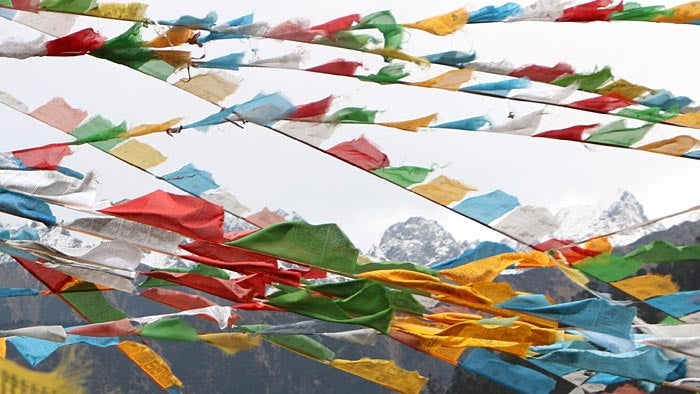
Anyone who has travelled in the Himalayas knows the sight: on passes and summits, above rooftops and in monastery courtyards, strings of colourful cloth flags move in the wind. Tibetan prayer flags are printed pieces of cloth in five colours, hung where the wind can reach them. In the Tibetan understanding, the wind carries the mantras, prayers and good wishes printed on them out in every direction, for the benefit of all beings.
In this article you will learn where prayer flags come from, what the wind horse and the five colours mean, and which prayers and symbols appear on the flags. You will also read when and where they are hung and how to treat them with respect, even when they are old and faded.
What are Tibetan prayer flags?
A Tibetan prayer flag is a square or rectangular piece of cloth printed with mantras, prayers and symbols. The flags are strung together in sets of five colours: blue, white, red, green and yellow. You find them in Tibet, in Nepal, in Bhutan and throughout the Himalayas wherever Tibetan culture is alive. Today they also hang in gardens and on balconies far beyond the Himalayas.
The horizontally strung flags are usually called Lungta in Tibetan, after the wind horse printed at their centre. There are also vertical flags on poles, called Darchog. Both rest on the same idea: what is printed on the cloth should not stay inside a book or a room, but spread with the wind.
The English term "prayer flag" captures this only in part. The flags do not carry requests up to a distant deity. In the Tibetan understanding, the wind spreads the blessings and compassion printed on them through all of space, so that every being nearby may share in them. Whoever hangs a prayer flag is therefore not thinking only of themselves.
Prayer flags are also the expression of an attitude deeply rooted in Tibetan culture: respect for the interdependence of all things and for the balance between people, animals, the elements and the deities of a place. A flag in the wind makes visible that one's own wellbeing and the wellbeing of others belong together.
Where do prayer flags come from?
The roots of prayer flags reach back to the time before Buddhism. Their origin is attributed to the Bön tradition, the ancient indigenous religion of Tibet. Even the early Bön flags were printed with woodblocks. They showed five animals: a horse at the centre, the wind horse, and a bird, a dragon, a lion and a tiger in the four corners. They did not yet carry any script. The wind horse belonged to the folk beliefs of the Tibetan plateau and was not originally a Buddhist idea.
In Buddhist India there were no prayer flags in this sense, but there were banners bearing short sutras or long dharanis, sacred formulas of many syllables. As Buddhism spread in Tibet, Tibetan Buddhists took up the familiar imagery of the five animals and added their own sacred texts. This is how the prayer flag as we know it today came about: a union of the Tibetan wind horse and the Buddhist banner. Over time countless variations followed, and to this day prayer flags are as alive in Buddhism as they are in Bön.
Closely connected with prayer flags is King Gesar of Ling, the hero of the great Tibetan epic. He is not regarded as their originator, yet he has a firm place in their tradition. On many later flags Gesar rides in place of the wind horse, surrounded by the four animals, and many prayers for raising the Lungta are addressed to him. A well-known prayer by Mipham Rinpoche advises, in essence, raising wind horse flags in the sky before an image of Gesar and setting out offerings.
Lungta, the wind horse
The wind horse is the heart of most prayer flags. The word Lungta combines "lung", wind or air, and "ta", horse. The horse is shown without wings and carries three flaming jewels on its back. They stand for the Three Jewels of Buddhism: the Buddha, the Dharma, meaning the teaching, and the Sangha, the community of practitioners. The horse stands for speed, the wind for movement. Together they carry the good wishes out into the world.
In Tibetan, Lungta has a second, everyday meaning. The word also describes a person's success, the favourable turn of circumstances that lets an undertaking come to a good end. When all goes well, people say a person's Lungta is spreading; when things go wrong, it has sunk. When Tibetans hang new prayer flags, they therefore speak of raising their Lungta.
In Buddhist practice this old image joins with a clear intention. The flags are not hung for one's own good alone, but with the wish that all beings may benefit. The wind horse thus becomes an image for something that lies in our own hands: a beginning made with a good heart.
The four animals in the corners
In the four corners of a Lungta flag appear four animals, often called the four dignities: the garuda, a mythical bird, the dragon, the snow lion and the tiger. They are a fixed part of the wind horse composition. Sometimes only their names appear in Tibetan script instead of images.
Which animal sits in which corner varies, and their interpretation differs between sources. Some teachers link the four animals to the elements, others to qualities that grow on the spiritual path, such as fearlessness, clarity and confidence.
The snow lion is also the emblem of Tibet. The garuda comes from Indian tradition; on the early Bön flags the bird had a different meaning, and a white yak was also counted among the animals there. The animals appear in the Gesar epic as well: there, the snow lion, garuda and dragon stand for the people of Ling, from whom Gesar came.
Lungta and Darchog: horizontal and vertical
The most common sight is the horizontally strung Lungta: many small flags sewn or tied to a cord and hung between two points, across a pass, between two houses or from one roof to the next.
Darchog are long, narrow lengths of cloth attached at the top of an upright pole and hanging down along it. The name means roughly flag on a pole. A Darchog usually bears the image of a deity with inscriptions and mantras. Such poles are set up on roofs, in front of houses, on cairns and along paths.
There is also the Darchen, literally the great flag: a tall wooden pole wrapped with hundreds of strings of flags. Widely known is the Tarboche at the foot of Mount Kailash, the sacred mountain in western Tibet. Every year at the Saga Dawa festival, on the full moon of the fourth Tibetan month, pilgrims lower the pole, dress it with new flags and raise it again together. Whether it then stands straight is seen by many as a sign for the year ahead.
The five colours and their order
A set of prayer flags consists of five colours, always strung in the same order from left to right: blue, white, red, green and yellow. On longer strings the sequence repeats.
Each colour stands for an element. Blue stands for the sky and space, white for air and wind, red for fire, green for water and yellow for earth. Together the five colours represent the five elements of which, in the Tibetan understanding, the whole visible world is made. A complete set shows them in balance: none is missing, none pushes ahead of the others.
This is why the colours of a set are not separated or rearranged. If a string is too long for the space, it is doubled back or the end is left to hang freely without touching the ground.
In some traditions and ritual texts, colours and elements are assigned differently. For prayer flags the order described here applies: blue, white, red, green, yellow, with sky, wind, fire, water and earth.
Mantras, prayers and auspicious symbols
Around the wind horse, the flag is densely printed with text. Tradition knows hundreds of mantras and prayers for prayer flags, each dedicated to a particular deity. Common ones are the mantra of Chenrezig, Om Mani Padme Hum, the mantra of Tara, Om Tare Tuttare Ture Soha, and the mantra of Guru Rinpoche, Om Ah Hung Benza Guru Padma Siddhi Hung.
Many flags also carry a long dharani, a sacred formula of several hundred syllables associated with the deity Dhvajagrakeyura. It was already widespread on the banners of Buddhist India. Its tradition stresses that this formula should be displayed on banners, for the benefit of all beings. Despite the length of the text, the four animals usually remain in the corners, sometimes with a small wind horse at the centre.
A flag often also contains a prayer for the person who hangs it: wishes for a long life, for wellbeing and for the success of their undertakings, sometimes with a blank space where one writes one's own name or birth year according to the Tibetan calendar.
Many flags show a deity or teacher instead of the wind horse, such as Green Tara, Chenrezig, Guru Rinpoche, the Medicine Buddha or King Gesar. The Eight Auspicious Symbols also appear on some flags, singly or as a group. Precisely because there are few fixed rules, a great variety of motifs has developed over the centuries.
Printed by hand: the woodblock
Traditionally, prayer flags are printed with woodblocks, called Parshing in Tibetan. For centuries, printing from wooden blocks was the predominant printing technique in Tibet, for sacred scriptures as well as for images and prayer flags. Tibetan printing houses still keep it alive today.
The carver cuts image and script into the wood in raised relief and in mirror image. To print, the block is coated with ink, the cloth is laid on top and pressed firmly until image and text transfer. Flag by flag, the work is done by hand, and no impression is exactly like another: one line may be stronger, one corner lighter. What looks at first like a small flaw is the trace of the hand that printed it.
A single block for a Lungta flag unites the wind horse, the four animals and the mantras in one carved image.
When are prayer flags hung?
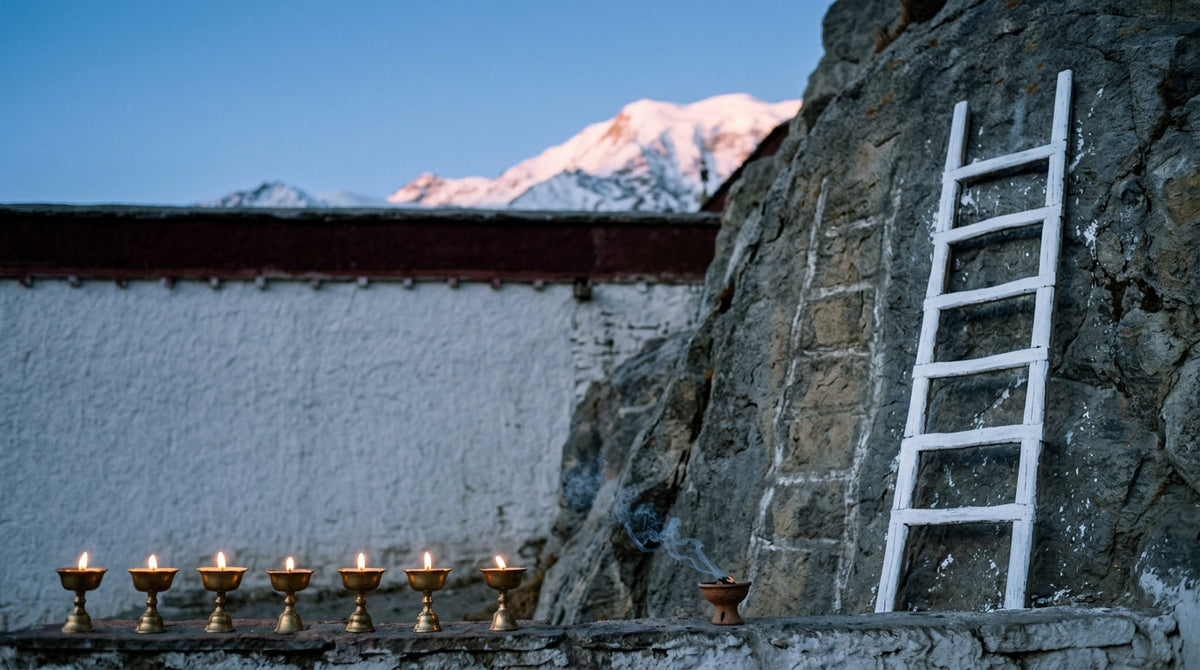
A fixed point in the year is Losar, the Tibetan New Year. On the third day, Chokyong Losar, the day of the protector deities, new flags are raised on the hills and around the houses. It is a Tibetan way of thanking nature, the local deities and the protector deities for the good of the past year and of asking for blessings for the new one. Often a smoke offering of juniper and herbs, called Sang in Tibetan, accompanies it. In many families the old flags are replaced with new ones in this way every year.
New flags are also hung on other occasions: at a new beginning, such as moving into a new home, on a pilgrimage, or when things are not going well and one wishes to raise one's Lungta again. A Sang offering is often made then as well.
Many families consult the Tibetan calendar for a favourable day. Days connected with the life of the Buddha are considered especially favourable, for example in the month of Saga Dawa, along with full moon and new moon. In general, Monday and Friday are regarded as good days for new flags. The calendar also marks unfavourable days on which no new flags are hung; tradition links them with a being called Baden. Flags that are already hanging are not affected. Because these days shift every year, it is worth looking at a current Tibetan calendar. The time of day matters too: new flags are ideally hung in the morning, on a sunny day with a little wind.
More important than the right day is the intention. Hanging prayer flags is traditionally joined with the wish that all beings may benefit, not only oneself. With this thought at heart, any day is a good beginning.
Where are prayer flags hung?
In Tibet, Nepal and Bhutan, prayer flags hang wherever the wind can reach them: on passes and summits, on slopes and rocks, on rooftops and around monasteries and stupas. On the pilgrimage route around Mount Kailash, pilgrims leave their flags on the passes as a sign of their journey and their good wishes.
At home, a garden, a balcony, a terrace or the space between two trees are all suitable. Hang the string as freely and as high as you can, so that it can move in the wind and does not catch in branches. Make sure the flags do not touch the ground and that the colour sequence of blue, white, red, green and yellow runs from left to right.
Prayer flags also belong indoors. In Tibetan homes and monasteries they hang in shrine rooms, in entrance areas and above the home altar. For indoor spaces there are smaller indoor prayer flags. Even without wind they keep their meaning, because in the tradition what counts is the intention with which they are hung.
You do not need to be a Buddhist to hang prayer flags. It is enough to treat them with respect and to know what is written on them.
Respectful handling of old prayer flags
Because prayer flags bear sacred texts and images, they are treated with respect, even when they are old. They do not belong on the ground or in the rubbish, and their cloth is not used for clothing.
That the colours fade and the cloth frays is part of the nature of prayer flags. In the Tibetan understanding, the flags carry their wishes onward for as long as the wind moves them. Many people leave old flags hanging until they dissolve of their own accord and hang new ones beside them. The sight of faded and fresh colours side by side is a reminder of impermanence and of the constant cycle of coming into being and passing away.
When old flags are taken down, it is Tibetan custom to burn them, mindfully and without letting them touch the ground. The smoke, so it is believed, carries their blessing onward. Some accompany this with a quiet wish for all beings or with a recitation of the Heart Sutra. In monasteries and communities, old flags are often taken down and burned together at Losar, before the new ones are hung.
Another traditional option is to keep old flags and texts in a clean, dry place where no one walks over them, such as a cave or a stupa. If you cannot light a fire at home, ask at a Buddhist centre whether old flags can be burned there. Flags made of synthetic material should not be burned.
Frequently asked questions about prayer flags
Which colour comes first?
Blue. From left to right follow blue, white, red, green and yellow, repeating in the same sequence on longer strings. The colours stand for sky, wind, fire, water and earth and belong together as a set.
How long do prayer flags stay up?
Until wind and weather have faded them. There is no fixed period. Many families renew their flags once a year at Losar; others hang new flags beside the old ones and leave those hanging until they dissolve.
May I shorten a string or cut off individual flags?
Better not. The five colours of a set belong together and represent the balance of the elements as a whole. If a string is too long, double it back or let the end hang freely without touching the ground.
What does the horse on prayer flags mean?
It is the wind horse, Lungta. It carries three flaming jewels that stand for the Buddha, Dharma and Sangha, and it carries the good wishes with the wind in every direction. In everyday language the word Lungta also stands for the success of a person and their undertakings.
Can prayer flags be given as a gift?
Yes. A prayer flag is a lovely gift for a new beginning, such as moving into a new home, or for Losar. Whoever gives one passes on a good wish that the wind carries further still.
Prayer flags in your everyday life
Whether on a Himalayan pass or on a balcony in Switzerland, a prayer flag is a wish that does not stay with oneself. Each time the wind moves it, it is a reminder of compassion, of the connectedness of all beings and of the fact that nothing lasts forever.
Our prayer flags are handcrafted by Tibetan artisans in the Himalayas and printed with woodblocks. Because each flag is stamped individually, no two are exactly alike. We wish that your flags may carry many good wishes into the wind.


Leave a comment
This site is protected by hCaptcha and the hCaptcha Privacy Policy and Terms of Service apply.